Choosing an orthopedic implant manufacturer requires more than comparing catalogues or advertised prices. A hip stem, a spinal screw, and a trauma plate each demand different design controls, materials, and production expertise. This guide introduces the top orthopedic implant manufacturers in China and explains what readers should examine before drawing conclusions. Details matter. The companies discussed may differ in product focus, manufacturing scale, and experience serving domestic or international markets. A broad portfolio does not automatically mean every product suits every clinical need.
The overview considers practical indicators, including product categories, documented quality systems, manufacturing capabilities, traceability, and publicly available evidence of clinical or regulatory readiness. Where information is limited or difficult to compare, that limitation should be made clear rather than filled with assumptions. Not always. Buyers and healthcare professionals should verify current certifications, product registrations, technical documentation, and service arrangements directly with each manufacturer and the relevant authorities. They may also ask how a company controls material batches, inspects components, and handles complaints after delivery. These questions can reveal important differences that a polished website cannot. Still, no list is final. Rankings can change as product lines, evidence, and market conditions evolve. Use this guide as a starting point for informed research, not as a substitute for clinical judgment, independent due diligence, or professional procurement review.
Orthopedic implants are medical devices placed in or on the body to support, replace, or stabilize bones and joints. Some help a fracture heal; others restore movement after joint damage. Their classification can seem confusing, because one device may fit several categories. That distinction matters. Clinicians commonly group implants by purpose, anatomical location, material, and design.
By function, plates, screws, and intramedullary nails hold fractured bones in position. Joint prostheses replace damaged surfaces, while spinal implants help stabilize selected segments. Materials may include titanium alloys, stainless steel, cobalt-chromium alloys, ceramics, or polymers. Each has different properties, such as strength, weight, and wear behavior. No material is best for every patient. Bone quality, anatomy, activity level, and the treatment plan all influence selection. Classification alone does not determine suitability.
Tips: Ask which anatomical area the implant is designed for and what it is meant to do. A useful discussion also covers material, expected recovery, and follow-up imaging. Details vary by case, and even familiar categories can hide important design differences. When uncertain, ask the treating orthopedic specialist to explain the options in plain language.
Orthopedic implants are commonly classified by their purpose and location, including fracture-fixation devices, joint replacements, spinal implants, and sports-medicine devices. Material choice depends on factors such as strength, wear resistance, and compatibility with bone. This chart compares representative elastic-modulus values; actual values vary by material grade and, for bone, measurement direction.
Top 10 Orthopedic Implant Manufacturers in China
How to Assess Orthopedic Implant Manufacturers in China
China’s National Bureau of Statistics counted 296.97 million residents aged 60 or older at year-end 2023. That was 21.1% of the population, according to its 2023 Statistical Communiqué on National Economic and Social Development. WHO’s World Report on Ageing and Health projects that one in six people worldwide will be 60 or older by 2030. These figures frame potential demand; they do not prove a supplier’s clinical value.
When assessing a manufacturer, verify the exact product registration and approved indications in China’s NMPA database. Request clinical evidence for the implant system, not just a company brochure. Check material certificates, dimensional tolerances, sterilization validation, packaging integrity, and batch-level traceability. Ask how complaints, recalls, and corrective actions are documented. Small details matter.
During a factory audit, compare written procedures with the actual production line. Review calibration records, clean-area controls, and product-release documentation. Confirm that test methods suit the implant’s intended use and relevant standards. For exports, check registration and labeling requirements in each destination market. A low quote may hide service gaps, while a large catalog can distract from weak evidence. I would still ask for longer-term clinical follow-up data; those results can be difficult to compare.
Use these ten criteria to compare suppliers. This checklist does not rank or identify individual manufacturers; verify each claim against the specific product and current regulatory records.
| No. | Assessment Dimension | What to Verify | Useful Evidence |
|---|---|---|---|
| 1 | Chinese regulatory status | Confirm that the exact implant model and intended use have the required NMPA registration or filing for the Chinese market. Many implantable orthopedic devices are Class III, but classification depends on the product. | Current NMPA registration information, certificate details, product name, model, intended use, and registration holder. |
| 2 | Quality management system | Check that the quality system covers the relevant manufacturing site and activities. ISO 13485 is a medical-device quality management system standard; certification alone does not establish product approval or performance. | Valid ISO 13485 certificate, certification scope, site information, and applicable audit or inspection records. |
| 3 | Material specifications | Match the implant’s material and grade to its technical documentation. Orthopedic devices may use materials such as titanium alloys, cobalt-chromium alloys, stainless steel, or polymers, depending on the product. | Material specifications, supplier controls, certificates of analysis, and product-specific test documentation. |
| 4 | Biological safety | Review biological evaluation appropriate to the device’s materials, nature, duration, and type of patient contact, using the relevant parts of the ISO 10993 series where applicable. | Biological evaluation plan and report, material characterization, and supporting test reports or justified assessments. |
| 5 | Mechanical performance | Assess performance against the product’s intended function and applicable standards or technical requirements. Test methods differ between product types, such as joint replacements, trauma fixation devices, and spinal implants. | Product-specific mechanical test protocols and reports, acceptance criteria, and design verification records. |
| 6 | Sterilization and packaging | For sterile products, confirm the sterilization method, validation, packaging integrity, and claimed shelf life. ISO 11135, ISO 11137, and ISO 17665 address ethylene oxide, radiation, and moist-heat sterilization processes, respectively, when applicable. | Sterilization validation, routine process controls, packaging validation, and shelf-life evidence for the supplied product. |
| 7 | Clinical evidence | Determine whether the clinical evidence supports the exact device, intended purpose, and patient population. Evidence requirements and routes depend on the product and applicable regulations. | Clinical evaluation documentation, relevant clinical investigation results where applicable, and post-market clinical follow-up information. |
| 8 | Traceability and change control | Check how the supplier identifies production lots, retains manufacturing records, handles complaints, and assesses changes to materials, processes, or specifications. | Sample lot records, traceability procedure, change-control process, complaint-handling procedure, and recall process. |
| 9 | Manufacturing capability | Confirm that the actual production site and processes are suitable for the implant, including machining, surface finishing, cleaning, inspection, and any special processes used. | Facility and process overview, inspection methods, equipment maintenance and calibration records, and relevant process validation. |
| 10 | Supply and service support | Evaluate delivery reliability, inventory arrangements, technical documentation, complaint response, and training or instrument support where relevant to the product. | Written service and delivery terms, product documentation, response procedures, and references that can be independently checked. |
Comparison note: Request evidence for the exact model and manufacturing site. Verify regulatory and certification information independently, and do not treat a certificate, test report, or supplier ranking as a substitute for product-specific due diligence.
China’s orthopedic implant sector spans joint replacement, trauma fixation, spinal devices, and sports medicine. A useful top-ten overview should compare more than sales or factory size. Look at product range, clinical evidence, manufacturing consistency, and after-sales support. These details matter in practice: surgeons need implants that fit varied anatomy, while hospitals need dependable supply and clear traceability. A ranking is imperfect. Public data does not always separate domestic sales from exports.
Market conditions add context. Fortune Business Insights estimated the global orthopedic implants market at USD 49.53 billion in 2023, projecting USD 72.54 billion by 2032. China’s procurement environment has also shifted: the National Healthcare Security Administration reported an average price reduction of about 82% in centralized procurement for artificial hip and knee joints. That pressure can widen access, but low prices alone do not prove quality. Buyers should review registration status, relevant clinical data, material specifications, and follow-up support. Details can be unevenly disclosed, so comparisons deserve caution. A strong manufacturer overview should distinguish verified capabilities from promotional claims.
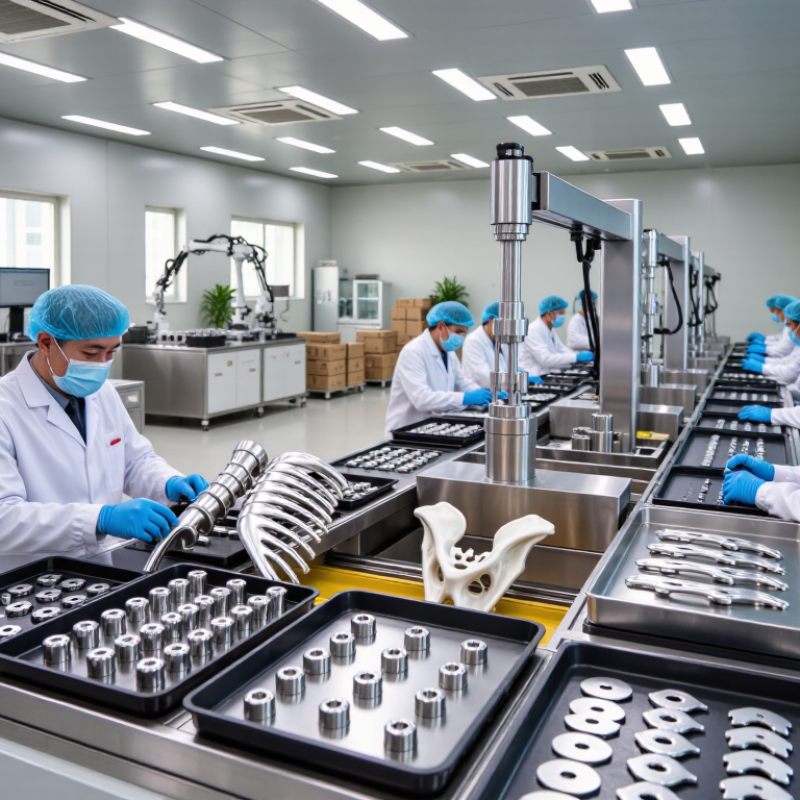
Chinese orthopedic implant manufacturers cover several distinct product areas. Trauma specialists make titanium plates, locking screws, and intramedullary nails for fractures in the wrist, femur, and lower leg. Some focus on spinal systems, including pedicle screws and connecting rods, while others produce hip and knee replacement components. Sports-medicine lines may include anchors and interference screws for ligament repair. These are not interchangeable specialties.
Materials and manufacturing details matter. Titanium alloys are common in fixation devices because they combine strength with relatively low weight. Joint components may use cobalt-chromium alloys, ceramic, or highly cross-linked polymer, depending on the design. Look closely at thread geometry, plate contours, porous coatings, and instrument compatibility. Small differences affect how a device fits and how a surgical team handles it. Useful evidence includes traceable material records, validated sterilization, and published clinical data—not just a polished catalogue. The picture is not perfectly uniform. Product breadth can signal manufacturing capacity, but it does not prove equal performance across every implant category. Hospitals and surgeons still need to assess device-specific evidence, training needs, and patient suitability.
China’s orthopedic implant industry is increasingly shaped by evidence requirements and centralized purchasing. In its 2021 national artificial-joint procurement results, the National Healthcare Security Administration reported 54 selected products and an average price reduction of 82%. That figure reflects affordability pressure, not a direct measure of clinical quality. Yet price isn’t performance.
For manufacturers, quality depends on more than polished implant surfaces. China’s registration framework and GB/T 16886 biological evaluation standards call for documented assessment of device-related risks. In practical terms, a porous titanium implant needs consistent pore structure, validated sterilization, and fatigue testing. Small process variations matter. Industry development is also moving toward additive manufacturing and more patient-specific designs, which can improve fit but demand stronger production controls. The NHSA procurement data shows how rapidly purchasing conditions can change; it does not establish whether lower prices improve long-term outcomes. That distinction still needs careful clinical follow-up.
They are devices placed in or on the body to support, replace, or stabilize bones and joints. Some hold a broken bone steady.
They can be grouped by purpose, body location, material, and design. One implant may fit several groups.
Plates, screws, and intramedullary nails can hold fractured bones in position. The choice depends on the fracture and treatment plan.
Common options include titanium alloys, stainless steel, cobalt-chromium alloys, ceramics, and polymers. Each has different strength, weight, and wear characteristics.
No. Bone quality, anatomy, activity level, and the treatment plan all affect suitability. Details matter.
Ask which body area it is designed for and what it is meant to do. Discuss material, recovery expectations, and follow-up imaging.
Review product-specific clinical evidence, material specifications, manufacturing consistency, traceability, and after-sales support. A broad catalogue alone proves little.
No. Centralized procurement lowered average hip and knee joint prices by about 82%, according to the article. Price alone cannot establish quality.
Public data may not separate domestic sales from exports. Disclosures can also vary, so comparisons deserve caution. We may need better evidence.
Orthopedic implants are medical devices designed to support, repair, or replace bones and joints. They can be grouped by their function and placement, including joint replacements, fracture-fixation devices, spinal implants, and other specialized products. When evaluating manufacturers in China, buyers should consider product range, engineering capabilities, manufacturing consistency, clinical suitability, quality-management practices, and the ability to provide reliable technical support.
This overview introduces the top orthopedic implant manufacturers by examining the capabilities and specialties found across the industry, without focusing on individual brand names. It also explains how leading manufacturers develop products for different orthopedic needs and how quality standards, advanced materials, digital manufacturing, and changing clinical requirements are shaping the sector. Together, these topics offer a practical framework for understanding China’s orthopedic implant market and comparing suppliers with a focus on product quality, innovation, and long-term reliability.