
Deep-Dive Engineering & Specification Standards for Custom OEM Large Fragment Instrument Sets in Hamburg
The Metropolitan Region of Hamburg stands as one of Northern Europe’s most demanding medical technology hubs. Hospitals operating under the Freie und Hansestadt Hamburg healthcare umbrella—ranging from maximum-care university medical centers to specialized traumatology clinics—demand uncompromising quality, absolute dimension stability, and complete compliance with European Union Medical Device Regulation (EU MDR 2017/745). For medical device brands, hospital procurement teams, and orthopedic distributors serving the German market, sourcing a Custom OEM Large Fragment Instrument Set requires moving beyond generic surgical tooling to engineered, highly traceable instrumentation tailored for complex long-bone trauma care.
Large fragment instrumentation primarily targets fractures of the femur, tibia, and humeral shaft, requiring tools optimized for 4.5 mm cortex screws, 6.5 mm and 7.3 mm cancellous screws, and 5.0 mm locking head screws. As an ISO 13485:2016 certified contract manufacturer, our production lines bridge high-precision German metallurgical standards (DIN EN ISO 7153-1) with flexible OEM engineering. We provide OEM contract manufacturing, custom sterilization container layout design, color-anodized ergonomics, and complete technical documentation (Technical Documentation/TD according to Annex II/III of Regulation EU 2017/745) to streamline your CE marking process and hospital procurement cycles.
Metallurgical Integrity: Premium Stainless Steel & Titanium Alloys
Surgeons in Hamburg trauma operating theaters require surgical tools that maintain sharp cutting edges, resist corrosion through hundreds of high-pressure steam sterilization cycles, and provide precise tactile feedback during reduction, reaming, and tapping. To meet these stringent specifications, we utilize certified medical-grade raw materials sourced with complete chemical and mechanical test certificates (EN 10204 3.1):
- Martensitic Stainless Steel (1.4125 / AISI 440C & 1.4116): Utilized for high-stress cutting elements including bone drills, countersinks, tap bits, and reamer heads. Vacuum heat treatment delivers a controlled surface hardness of 52 to 56 HRC, maintaining razor-sharp cutting geometry without micro-chipping during cortical bone penetration.
- Austenitic Stainless Steel (1.4301 / AISI 304 & 1.4404 / AISI 316L): Employed in structural instrument components, handles, bending irons, and depth gauges. Provides superior corrosion resistance under aggressive enzymatic cleaning agents and harsh washer-disinfector chemicals.
- Titanium Alloy (Ti-6Al-4V ELI / Grade 5 - ASTM F136): Integrated into lightweight instrument components, dynamic neutralization sleeves, and color-coded alignment guides where weight reduction and non-magnetic property profiles are crucial during intraoperative fluoroscopy or intraoperative CT scanning.
- Advanced Polymer Integration (Radel® PPSU & Silicone): Ergonomic handles feature medical-grade Polyphenolsulfone (PPSU) or over-molded vulcanized silicone, engineered to withstand repeated 134°C (273°F) saturated steam sterilization without embrittlement, color degradation, or chemical leaching.
UKE Hamburg-Eppendorf Trauma Center
Clinical Focus: Polytrauma & Complex Femoral Fractures
At major trauma hubs such as Universitätsklinikum Hamburg-Eppendorf (UKE), surgeons handle severe polytrauma resulting from high-energy transport accidents. Our custom large fragment sets feature quick-coupling 4.5mm/5.0mm tissue-protecting double drill sleeves, heavy-duty Verbrugge bone holding forceps, and self-holding star-drive screwdrivers that reduce operative time during emergency femoral fixation.
BG Klinikum Boberg Maritime Injuries
Clinical Focus: Industrial & Port Heavy Trauma
Serving the Port of Hamburg (Hafen Hamburg) and industrial maritime sectors, BG Klinikum Boberg specializes in occupational crush injuries and complex non-unions. Our set includes high-torque anatomical bending irons, heavy-duty plate cutters, and universal rod-holding clamps designed to mold large 4.5mm titanium dynamic compression plates to severe tibial shaft deformities.
Asklepios Klinik St. Georg & Altona
Clinical Focus: Periprosthetic Revision & Geriatric Trauma
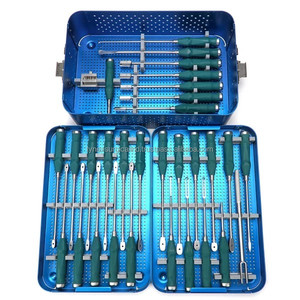
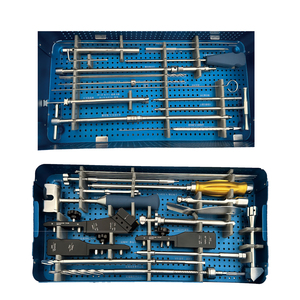
High-volume surgical units at Asklepios facilities require rapid OR turnover and standardized instrument layouts. Our custom-designed aluminum/silicone sterilization trays (1/1 DIN container compliant) organize tools by logical surgical steps (Ream → Measure → Tap → Drive), reducing scrub nurse setup times and preventing intraoperative delay during revision cases.
Technical Comparison: Standard Off-the-Shelf vs. Custom OEM Large Fragment Instrument Sets for the German Market
German healthcare buyers and distributors must balance capital expenditure against clinical reliability and regulatory liability. The technical matrix below highlights how our specialized OEM manufacturing capabilities compare to generic commercial sets:
| Parameter / Feature | Standard Off-the-Shelf Sets | Orthi Medical Custom OEM Set (Hamburg Grade) |
|---|---|---|
| Material Certification | Generic Stainless Steel (Traceability limited) | EN 10204 3.1 Material Certificates for 1.4125, 1.4301 & Ti-6Al-4V ELI |
| Machining Tolerances | ±0.03 mm to ±0.05 mm | Strict ±0.005 mm via 5-Axis DMG MORI CNC Machining |
| Autoclave Cycle Rating | Approx. 100–150 Sterilization Cycles | 500+ Cycles (134°C Steam Saturated / DIN EN ISO 17665-1 Compliant) |
| Color Anodizing & Marking | Standard Ink Laser (Fades after cleaning) | Deep Passivated Fiber Laser UDI GS1 DataMatrix + Anodized Coding |
| Tray Compatibility | Non-standard plastic trays | 1/1 DIN Standard Container Architecture (Fits Aesculap, KLS Martin, R conquest) |
| EU MDR 2017/745 File Support | Basic Certificate Only | Complete Technical Documentation (GSPR, Biocompatibility, Risk Analysis ISO 14971) |
Market Dynamics & Regulatory Trends Shaping Hamburg’s Medical Device Landscape
The German orthopedic market is experiencing a profound structural shift driven by European regulatory updates, hospital centralization under the Krankenhausreform, and environmental sustainability initiatives. Distributors and OEM brand owners in Hamburg must adapt to several critical market trends:
1. The Rigor of EU MDR 2017/745 and Contract Manufacturing Dynamics
The transition from the legacy Medical Device Directive (MDD 93/42/EEC) to the Medical Device Regulation (EU MDR 2017/745) has increased administrative and clinical requirements for medical device registration across Germany. Class I, Class IIa, and Class IIb reusable surgical instruments require rigorous verification of cleanability (ISO 17664), biocompatibility (ISO 10993), and lifetime cycle validation. OEM buyers in Hamburg can no longer rely on suppliers who provide unvalidated products. Orthi Medical supports OEM clients by providing comprehensive technical files, raw material melt certificates, process validation protocols (IQ/OQ/PQ), and complete batch traceability, dramatically reducing the regulatory burden on European Authorized Representatives (EC REP) and distributors.
2. DRG Cost-Efficiency & Sterilization Process Optimization
Under Germany’s G-DRG (German Diagnosis Related Groups) system, hospitals face fixed reimbursement rates for trauma procedures. Operating Room (OR) time in Hamburg hospitals is valued at up to €40–€60 per minute. Efficient large fragment instrument sets—featuring intuitively color-coded drill sleeves, quick-release ratcheting handles, and multi-functional reduction pliers—minimize intraoperative instrument swaps. Furthermore, our customized tray layouts facilitate fast cleaning in automated washer-disinfectors (ISO 15883 compliance), minimizing hospital Central Sterile Supply Department (CSSD/AEMP) bottlenecking.
3. Green Hospital Initiatives & Circular Instrumentation Trays
Hamburg’s municipal environmental mandates push healthcare institutions toward carbon-neutral purchasing and zero single-use plastic waste. Reusable stainless steel and titanium instrument sets housed in long-life anodized aluminum container systems align perfectly with these ecological targets. Our tray designs utilize modular PPSU brackets that allow replacement of individual worn components without discarding the entire instrument case, significantly lowering the total cost of ownership (TCO).
Why Partner with Orthi Medical for Hamburg OEM Contract Manufacturing?
Orthi Medical Co., Ltd. brings decades of advanced manufacturing expertise to the global orthopedic device supply chain. Operating state-of-the-art production hubs equipped with 5-axis DMG MORI CNC milling machines, Swiss-type automatic turning centers, and fully automated surface passivation lines, we offer complete OEM/ODM solutions tailored for German distributors:
Precision Manufacturing
Micron-level accuracy (±0.005 mm) ensuring seamless instrument-to-implant fit, preventing thread stripping or head slippage during screw insertion.
Customization & Private Label
Custom laser-etched logos, part numbers, UDI GS1 DataMatrix barcode engraving, and customized silicone holder layouts tailored to your exact set configuration.
Co-60 Gamma Sterilization
In-house capability for pre-sterilized single-use implant options and double-sterile barrier blister packaging matching ISO 11607 standards (SAL 10-6).
Expand Your Surgical Product Portfolio in Hamburg & Europe
Connect with our OEM engineering team to request sample sets, CAD drawings, material certificates, or complete EU MDR technical file documentation for custom large fragment instrumentation.
Inquire Now