Featured Orthopedic Systems & Medical Devices
Explore our high-precision implant portfolios, surgical instrument sets, and specialized healthcare solutions manufactured under rigorous ISO 13485 quality standards.

1. Executive Overview: Trusted Engineering in Orthopedic Device Manufacturing
The global demand for high-reliability medical implants has elevated the benchmark for critical manufacturing standards. Hospital procurement committees, orthopedic surgeons, and international distributors require absolute assurance regarding bio-compatibility, biomechanical stability, and precise geometric fidelity. As a premier original equipment manufacturer (OEM) and supplier specializing in advanced musculoskeletal solutions, our manufacturing ecosystem addresses complex trauma, spinal fixation, joint arthroplasty, and sports medicine needs.
Operating under fully validated cleanroom conditions and maintaining rigorous conformance to ISO 13485 and ISO 9001 quality management systems, our manufacturing facilities integrate full multi-axis CNC swiss-turning, high-precision milling, passivating chemical treatments, and advanced volumetric inspection protocols. Every internal fixation system—ranging from distal radius volar locking plates to titanium pelvic reconstruction arrays—is engineered to minimize operative complications, eliminate stress shielding, and accelerate osseointegration.
Rigorous Material Traceability
Every batch of raw medical titanium, PEEK (Polyetheretherketone), or cobalt-chromium alloy undergoes spectrographic melt validation. Mill certificates are linked to individual lot numbers, ensuring full backward traceability from final implant package to raw bar stock.
Sterile Packaging & Gamma Irradiation
Implants can be supplied in pre-sterilized double-blister packaging subjected to Cobalt-60 ($\text{Co}^{60}$) gamma-ray irradiation, achieving a validated Sterility Assurance Level (SAL) of $10^{-6}$ compliant with ISO 11137 standards.
Custom OEM/ODM Engineering
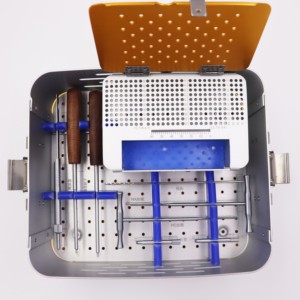
Our technical engineering team converts CAD/CAM schematics into production-ready CNC paths. We support proprietary surgical instrument design, specialized color-coded anodization, laser engraving, and custom sterilizing tray production.
2. Biomechanical Engineering & Product Line Innovations
Different anatomical pathways demand highly tailored material properties and biomechanical geometries. Our production capabilities span major clinical sub-specialties:
Trauma Internal Fixation Systems
Trauma care requires versatile fixation options capable of managing osteoporotic bone tissue, complex multi-fragmentary fractures, and peri-articular disruptions. Our locking compression plate (LCP) family utilizes combi-holes that allow surgeons to choose between conventional compression and dynamic locking.
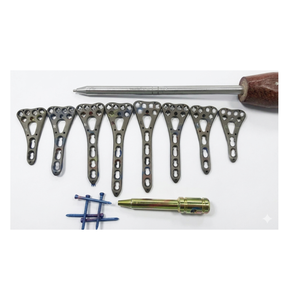
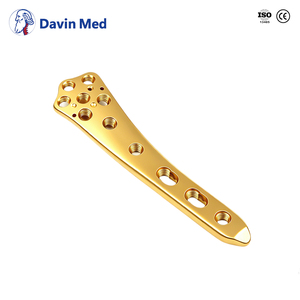
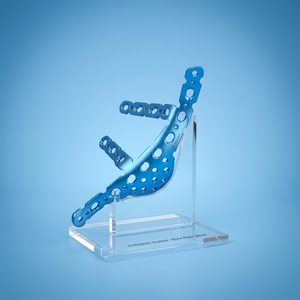
- Distal Radius Volar Plates: Designed with anatomical contours matching the volar lip of the radius. Variable-angle locking screws allow targeted subchondral screw placement, preserving articular congruence.
- Pelvis Reconstruction Systems: Engineered with malleable Grade 2 Titanium or TC4 titanium alloy, permitting intraoperative contouring without compromising structural fatigue strength.
- Intramedullary Tibia & Femoral Nails: Featuring multi-planar proximal and distal locking configurations to control rotational instability in diaphysis fractures.
Spinal Instrumentation & Minimally Invasive (MIS) Tools
In spinal intervention, precision is paramount. Our thoracolumbar pedicle screw systems utilize dual-lead threads to expedite insertion while maximizing pull-out strength in cancellous bone. Concurrently, minimally invasive spinal surgical techniques are enhanced by specialized tooling:
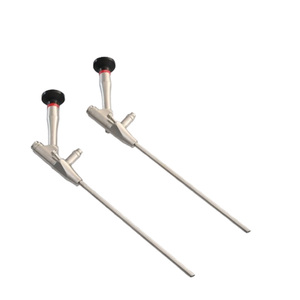
The Percutaneous Endoscopic Spine Instrument (PTED) System ($6.3\text{mm} \times 181\text{mm}$) enables targeted discectomy and decompression under local anesthesia. By incorporating high-grade stainless steel working channels and erosion-resistant micro-forceps, surgeons can perform lumbar disc herniation procedures with minimal tissue trauma and reduced recovery times.
| Material Standard | Common Trade Name | Tensile Strength (MPa) | Biomechanical Application | Key Clinical Advantage |
|---|---|---|---|---|
| ASTM F1472 / ISO 5832-3 | Ti-6Al-4V (TC4) | $\ge 930$ | Trauma Plates, Pedicle Screws, Joint Stems | High fatigue resistance, excellent strength-to-weight ratio |
| ASTM F67 / ISO 5832-2 | Unalloyed Pure Titanium (Grades 2-4) | $400 - 550$ | Pelvic Reconstruction, Cranio-Maxillofacial | Superior ductility and cold-formability during surgery |
| ASTM F2026 | PEEK Optima | $90 - 120$ | Interbody Fusion Cages, Suture Anchors | Modulus close to human cortical bone, radiolucent |
| ASTM F138 / ISO 5832-1 | 316L Stainless Steel | $\ge 860$ | Temporary Trauma Screws, Surgical Instruments | High stiffness, cost-effective short-term fracture fixation |
3. Strategic Future Procurement Trends in Orthopedic Sourcing
Medical device procurement officers are recalibrating their global supply chain strategies to adapt to tightening regulatory frameworks (such as EU MDR compliance) and macroeconomic shifts. Understanding upcoming procurement vectors enables hospital systems and distributors to build resilient vendor networks:
Shift Towards Gamma-Sterile Single Packaged Implants
Hospitals are transitioning away from non-sterile implant inventory trays that require in-house autoclaving. Sterile single-pack items eliminate hospital reprocessing costs, prevent cross-contamination risks, and optimize Operating Room (OR) turnover efficiency. Procurement contracts increasingly demand SAL $10^{-6}$ pre-packaged readiness.
Demand for Value-Based Healthcare & OEM Standardization
Tier-1 hospital chains are looking beyond premium brand premiums, actively seeking direct partnerships with certified OEM manufacturers. Direct sourcing of standardized trauma plates and cannulated compression screws reduces device costs by 35% to 50% without compromising clinical efficacy or safety standards.
Regulatory File Readiness (CE & 510(k))
Procurement teams are prioritizing suppliers who deliver complete regulatory submission packages—including biocompatibility testing (ISO 10993), mechanical fatigue data (ASTM F1264 / ISO 7206), and process validation documentation—accelerating market authorization across new territories.
4. Next-Generation Technological Trends in Orthopedic Engineering
The musculoskeletal sector is experiencing a paradigm shift driven by material science, digital planning, and minimally invasive techniques. Key technology drivers over the coming decade include:
1. Additive Manufacturing & Porous Trabecular Titanium Structures
Selective Laser Melting (SLM) and Electron Beam Melting (EBM) 3D printing technologies allow manufacturers to create biomimetic porous surfaces directly integrated into titanium implants. Trabecular structures with porosity levels between 60% and 80% simulate natural cancellous bone, significantly promoting osteoblast proliferation and rapid biological bony ingrowth while preventing stress shielding.
2. Expansion of Unilateral Biportal Endoscopy (UBE) and MIS Instrumentation
Traditional open spinal procedures are continuously yielding to endoscopic approaches. Unilateral Biportal Endoscopy (UBE) utilizes separate portals for visualization and working instruments. As a result, there is growing demand for specialized ultra-slender, highly durable micro-instruments, high-definition 4K endoscopic camera integration, and bipolar radiofrequency plasma ablation probes.
3. Surface Coating Innovations (HA & Antibacterial Ion Layering)
Plasma-sprayed Hydroxyapatite (HA) coatings on cementless femoral stems and acetabular cups foster enhanced primary fixation. Furthermore, emerging surface modification research focuses on silver-ion deposition and titanium nitride (TiN) physical vapor deposition (PVD) to mitigate bacterial adhesion and implant-associated infection rates.
5. Frequently Asked Questions (FAQ) for B2B Procurement Managers
Addressing critical technical, regulatory, and logistics queries for medical device distributors and hospital purchasing teams.
Partner with a World-Class Orthopedic Implant Manufacturer
Leverage our advanced CNC production infrastructure, ISO 13485-certified quality systems, and turnkey OEM services to strengthen your medical device portfolio. Contact our technical engineering and international sales department today for detailed product catalogs, custom pricing, or sample evaluations.