Featured Orthopedic & Spinal Implant Systems
Precision-Engineered Surgical Solutions Supplied Direct from ISO 13485 Certified Manufacturing Facilities
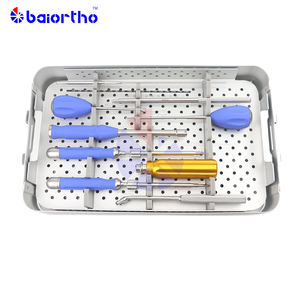
Veterinary Spine Fixation System, Stable Spinal Implant Kit for Small Animal Surgery
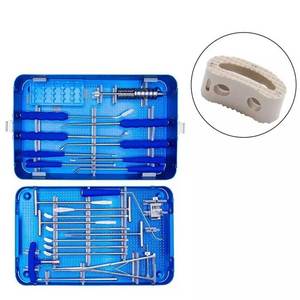
Azicon's TLIF PEEK Cage Instrument Set Transforaminal Lumbar Interbody Fusion Spinal Kit
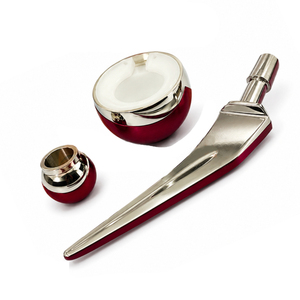
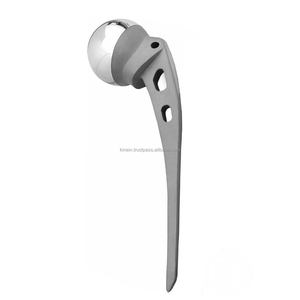
Austin Moore Hip Joint Prosthesis Cemented Femoral Stem Hemiarthroplasty Steel Implant
Biomechanical Superiority & Engineering of Expandable Interbody Cages
The global spinal fusion market is undergoing a fundamental paradigm shift from static interbody spacers to dynamically expandable fusion systems. Traditional static interbody devices, whether manufactured from polyetheretherketone (PEEK) or dense titanium alloys, present inherent surgical trade-offs. Inserting a static cage with sufficient height to restore intervertebral disc clearance and sagittal alignment requires significant nerve root retraction and aggressive endplate preparation, increasing the risk of intraoperative neurological injury and structural endplate disruption.
Expandable interbody cages address these biomechanical limitations directly. Designed for inserted collapsed profiles and expanded *in situ*, these devices allow spine surgeons to pass implants through reduced anatomical windows—such as minimal neural corridors in Transforaminal Lumbar Interbody Fusion (TLIF) or Posterior Lumbar Interbody Fusion (PLIF) approaches. Once positioned precisely within the disc space, the mechanical actuation mechanism expands the device vertically and lordotically, optimizing endplate contact, restoring natural anatomical curvature, and reducing endplate stress concentrations that lead to early cage subsidence.
Continuous vs. Stepped Expansion Mechanics
Our OEM/ODM expandable interbody systems utilize advanced internal drive screw and internal bevel gear configurations. Unlike discrete stepped expansion systems that force height adjustments in pre-determined increments, continuous thread-driven expansion mechanisms allow infinite adjustability within the clinical range (typically 8mm collapsed to 14mm fully expanded). This enables surgeons to tactilely feel the exact moment of appropriate endplate engagement and cortical tension, minimizing over-distraction while maximizing primary stability.
Endplate Subsidence Mitigation
By maximizing the surface footprint prior to height expansion, contact stress is distributed evenly across the peripheral apophyseal ring, dramatically decreasing peak loads on central cancellous bone.
In-Situ Lordotic Adjustment
Integrated dual-wedge drive mechanisms enable independent or proportional lordotic angle adjustment (0° to 15°), custom restoring patient-specific lumbar lordosis.
Post-Expansion Graft Delivery
Engineered central chambers allow surgeons to pack autograft or allograft bone material through dedicated delivery cannulas *after* achieving final expansion height, ensuring zero internal voids.
Material Technology: Porous 3D Titanium vs. Carbon-PEEK Composite
Choosing the correct biomaterial matrix is vital for achieving early osseointegration and long-term radiolucency. As a premier OEM contract manufacturer, we specialize in processing both medical-grade Ti-6Al-4V ELI (ASTM F136 / ASTM F1472) and PEEK-OPTIMA polymers:
- Selective Laser Melting (SLM) Porous Titanium: 3D-printed titanium implants featuring interconnecting porous architectures (pore size 300–600 μm, porosity 65–75%) mimic natural trabecular bone structure. This porous lattice reduces the modulus of elasticity closer to native cancellous bone, facilitating vascularization and osteoblast migration directly into the body of the cage.
- PEEK with Titanium Endplates / Plasma Coatings: Combining the radiolucency and low modulus of PEEK with plasma-sprayed pure titanium (ASTM F67) endplate coatings offers optimal imaging clarity under X-ray/CT alongside mechanical osteo-conduction at the bone-implant interface.
| Mechanical Specification | Static PEEK Cage | Static Porous Ti Cage | OEM Expandable Ti/PEEK System |
|---|---|---|---|
| Insertion Profile (Width / Height) | 10mm / 12mm (Fixed) | 10mm / 12mm (Fixed) | 8mm Collapsed (Expands to 14mm) |
| Endplate Contact Surface Area | Moderate (Fixed) | Moderate (Fixed) | Maximized Post-Expansion (+35%) |
| Neural Corridor Clearance Requirement | High (Risk of impaction stress) | High (Risk of impaction stress) | Minimal (Smooth low-profile insertion) |
| ASTM F2077 Static Compression Load | > 15 kN | > 22 kN | > 18 kN (Fully Expanded State) |
| Modulus Matching to Bone | 3.6 GPa (PEEK Body) | 1.5 – 3.0 GPa (Porous Lattice) | Engineered Structural Equilibrium |
Future Procurement Trends in Spinal Fusion Implants (2025–2035)
For medical device brands, OEM contract buyers, and regional healthcare distributors, maintaining market competitiveness requires anticipating global regulatory and technological shifts. Procurement trends over the next decade indicate a definitive movement toward fully integrated, minimally invasive surgical systems.
1. Integration with UBE & Endoscopic Surgery
The surge in Unilateral Biportal Endoscopy (UBE) demands ultra-slim expandable cages capable of passing down narrow working sleeves (Ø 10mm–12mm) without sacrificing expansion capability or structural graft volume.
2. Sterile Packaged Single-Use Delivery
Global procurement offices are transitioning away from reusable hospital tray sterilization to pre-sterilized (Co-60 Gamma, SAL 10⁻⁶) single-use implant kits. This minimizes hospital reprocessing overhead and eliminates cross-contamination risks.
3. OEM Supply Chain Consolidation
Distributors are consolidating sourcing to single-source OEM partners capable of supplying complete surgical ecosystems—combining pedicle screw systems, expandable cages, shaver blades, and precise surgical instruments.
Advanced OEM/ODM Contract Manufacturing Capabilities
Orthi Medical operates fully integrated manufacturing cleanrooms and micro-machining centers. We partner with international medical device enterprise customers to transition initial CAD concepts into CE-marked, FDA-ready commercial implant systems.
End-to-End OEM Engineering Workflow
- Precision Swiss CNC & Wire EDM: 5-axis DMG MORI and Citizen Swiss CNC lathes enable precision machining of intricate drive gears, internal expansion wedges, and locking mechanisms with tolerances within ±5 micrometers.
- Biomechanical Testing & Validation: Implants undergo stringent mechanical testing per ASTM F2077 (Static & Dynamic Axial Compression, Torsion) and ASTM F2267 (Measurement of Subsidence under Static Axial Load).
- Surface Functionalization: Controlled anodization (Type II & Type III color coding), bead blasting, chemical etching, and vacuum plasma spraying ensure superior fatigue life and immediate osteoconductivity.
- Full Regulatory Technical Dossier Support: We supply our global partners with raw material mill certificates, bio-compatibility reports (ISO 10993), sterilization validation packages, and complete technical files for CE Marking and local FDA filings.
Procurement FAQ: Global Buyer Sourcing Guide
Direct Answers to Essential Technical, Regulatory, and Commercial Procurement Inquiries
What certifications and material standards govern your expandable interbody cages?
Our quality management system is fully certified under ISO 13485 and ISO 9001. Raw materials conform strictly to international medical standards: Medical-grade Titanium Alloy per ASTM F1472 / ASTM F136 (Ti-6Al-4V ELI), Unalloyed Titanium per ASTM F67, and PEEK-OPTIMA per ASTM F2026. Every production batch includes complete raw material mill certificates and chemical inspection heat-number traceability.
Do you provide full OEM/ODM customization based on our engineering drawings or sample designs?
Yes. Our engineering division offers complete contract manufacturing services, including reverse engineering, Finite Element Analysis (FEA) optimization, rapid prototyping, micro-machining, laser marking, customized anodizing color schemes, and private-label packaging. We regularly manufacture custom expansion profiles, specialized footprint sizes, and unique lordosis angles.
Can implants be delivered in gamma-sterilized packaging ready for surgical use?
Absolutely. Implants can be processed inside our Class 100,000 (ISO Class 7) cleanrooms and packaged in double-peel Tyvek blister trays. Products undergo Cobalt-60 (Co-60) Gamma Irradiation to achieve a Sterility Assurance Level (SAL) of 10⁻⁶ compliant with ISO 11137 standards, with a validated shelf life of 5 years.
How do expandable interbody cages ensure structural safety against dynamic collapse under in-vivo axial loads?
Our expandable mechanisms feature internal anti-backdrive thread geometry and secondary mechanical locking screws. Once the surgeon reaches the target height expansion, the drive shaft locks mechanically, preventing reverse rotation or height loss under peak physiological dynamic loads (> 3.0 kN dynamic fatigue limit tested over 5,000,000 cycles per ASTM F2077).
What is the minimum order quantity (MOQ) and lead time for OEM contract manufacturing orders?
For standard catalog items, MOQs start as low as 20–50 units per specification. For custom OEM/ODM development, prototype machining and testing samples are typically completed within 3 to 4 weeks, with full commercial mass production batch lead times ranging between 30 and 45 days depending on regulatory packaging requirements.
How is bone graft material introduced into an expanded cage post-expansion?
Our expandable cage designs feature specialized hollow insertion shafts that double as graft delivery channels. After the expander tool achieves final cage expansion, a specialized bone graft funnel attaches to the instrument handle, allowing synthetic or autogenous bone graft to be injected under pressure directly into the expanded central graft lumen.
Which surgical approaches are your expandable cage systems designed to support?
We manufacture dedicated expandable cage systems tailored for Transforaminal Lumbar Interbody Fusion (TLIF), Posterior Lumbar Interbody Fusion (PLIF), Lateral Lumbar Interbody Fusion (LLIF/Direct Lateral), and Anterior Lumbar Interbody Fusion (ALIF), alongside matching ergonomic surgical instrument trays.
What technical and regulatory documentation is provided to support regional distributor registration?
We provide full technical dossier support including ISO 13485 certificates, CE certificates of conformity, ISO 10993 biological evaluation reports, ASTM mechanical test summaries, shelf-life validation reports, surgical technique guides (STGs), and Instructions for Use (IFU) translated into target commercial languages.