Featured Orthopedic & Surgical Portfolio
Explore our core ISO 13485 certified implant systems, instruments, and custom OEM manufacturing solutions
1. Technical Whitepaper: The Evolution of 3D Printed Titanium Spinal Cages
The paradigm of spinal interbody fusion has undergone a monumental shift. Traditional subtractive manufacturing—which relies heavily on machining solid titanium alloys or injection-molding Polyetheretherketone (PEEK)—presents persistent clinical trade-offs. Machined solid titanium implants exhibit an elastic modulus (~110 GPa) significantly higher than natural human cortical bone (~12–18 GPa) and trabecular bone (~0.5–5 GPa), frequently triggering stress shielding, localized bone resorption, and cage subsidence. Conversely, while non-porous PEEK provides a elastic modulus closer to bone, it is fundamentally hydrophobic and bio-inert, resulting in encapsulation by fibrous tissue rather than true osteointegration.
As a premiere OEM/ODM 3D printed titanium cage factory & supplier, Orthi Medical leverages Laser Powder Bed Fusion (LPBF) and Selective Laser Melting (SLM) additive manufacturing to eliminate these clinical bottlenecks. By fusing medical-grade Ti-6Al-4V ELI (Extra Low Interstitial) alloy powder layer by layer, 3D printing enables the fabrication of complex, biomimetic porous lattice architectures. These interconnected open-pore matrices directly mimic natural human cancellous bone structure, offering an optimal modulus of elasticity (3.0–4.5 GPa), facilitating rapid cell seeding, vascularization, and definitive bony ingrowth (osseointegration) without requiring excessive biological bone graft materials.
Key Engineering Benchmark: Additive manufactured porous titanium structures constructed by Orthi Medical demonstrate a 300% increase in shear strength at the bone-implant interface compared to traditional plasma-sprayed titanium coatings, while maintaining dynamic compression fatigue strength well above ASTM F2077 and ISO 14801 limits.
Biomechanical & Clinical Comparison: Machined Ti vs. PEEK vs. 3D Printed Lattice Titanium Cages
| Performance Parameter | Machined Solid Ti-6Al-4V | Polyetheretherketone (PEEK) | Orthi Medical 3D Printed Ti Lattice |
|---|---|---|---|
| Elastic Modulus (GPa) | 110 GPa (High risk of subsidence) | 3.6 GPa (Close to cancellous bone) | 3.0 – 4.8 GPa (Optimized matching) |
| Osseointegration Mechanism | On-growth only (Surface limited) | Fibrous encapsulation (Bio-inert) | In-growth & Through-growth (3D bio-lattice) |
| Imaging Artifacts (CT / MRI) | Significant metallic scatter | Radiolucent (Requires pin markers) | Minimal scatter due to porous topology |
| Graft Window Volume | Restricted by solid wall machining | Moderate window area | Maximized internal/external bone graft capacity |
| Subsidence Rate (Clinical) | Elevated (Rigid stress concentration) | Moderate (Edge deformation) | Significantly reduced (Load distribution) |
| OEM/ODM Customization | High tooling costs, rigid geometries | Extrusion molding limited | Seamless CAD-to-Print patient anatomical match |
2. OEM & ODM Manufacturing Architecture: From Blueprint to Sterile Delivery
Orthi Medical operates as a specialized full-service contract manufacturer for international medical device brand owners, orthopedic distributors, and clinical institutions. Our industrial additive manufacturing facility incorporates advanced multi-laser Selective Laser Melting systems alongside high-precision 5-axis CNC Swiss machining centers, establishing a turnkey pipeline for spinal, trauma, and joint reconstruction devices.
End-to-End OEM/ODM Production Workflow
- Design for Additive Manufacturing (DFAM): Our biomedical engineering team transforms client 2D/3D CAD models (STEP/IGES/STL) into optimized lattice topologies. We perform Finite Element Analysis (FEA) to simulate biomechanical strain distributions and optimize strut thickness (typically 200–400 μm) for target load profiles.
- Raw Material Qualification (ASTM F136 / ISO 5832-3): We exclusively utilize spherical grade 23 Ti-6Al-4V ELI titanium powder with strictly controlled particle size distribution (PSD 15–45 μm), spherical morphology >90%, and ultra-low oxygen content (<0.10%) to guarantee defect-free layer fusion.
- Additive Layer Fabrication: Utilizing closed-loop inert Argon environments with real-time oxygen monitoring (<100 ppm), our LPBF printers build components with micro-layer precision (20–40 μm layer thickness), achieving consistent structural density throughout complex internal channels.
- Post-Processing & Thermal Densification: Raw printed components undergo vacuum stress-relief annealing and Hot Isostatic Pressing (HIP) per ASTM F3001 (920°C, 100 MPa Argon atmosphere for 2 hours) to completely eliminate internal microporosity, maximizing dynamic fatigue life.
- Automated De-powdering & Surface Functionalization: Unfused metal powder is evacuated using multi-axis ultrasonic vibration and high-pressure chemical fluidization. Cages undergo controlled chemical etching to produce a micro-nano surface roughness (Ra 3–5 μm) that accelerates osteoblast attachment.
- Subtractive Machining & Quality Inspection: Mating features, threads, and instrument interface notches are precision-milled using high-precision CNC equipment. 100% of finished implants undergo Coordinate Measuring Machine (CMM) dimensional verification and optical surface scan.
- Cleanroom Packaging & Gamma Sterilization: Products are washed in multi-stage ultrasonic deionized water systems, labeled with full lot traceability laser-marking, and packaged in ISO Class 7 cleanrooms inside double Tyvek blisters ready for Gamma Co-60 irradiation (SAL 10-6).
3. Comprehensive 3D Printed Titanium Cage Product Spectrum
Our factory produces an extensive range of anatomical spinal fusion implants engineered for cervical, thoracic, and lumbar interventions. Each product line can be customized via OEM private labeling or modified per clinical preference:
A. Cervical Interbody Fusion Systems (ACDF)
Designed for anterior cervical discectomy and fusion, our 3D printed cervical cages feature an anatomical lordotic angle (0° to 12°) and expansive graft cavities. The micro-textured tooth profile on superior and inferior surfaces provides instant primary fixation and prevents cage migration without harming endplate integrity. Available as standalone cages or zero-profile integrated screw systems.
B. Lumbar Interbody Fusion Portfolio (PLIF, TLIF, ALIF, LLIF / XLIF)
- TLIF / PLIF Cages: Bullet-nosed and curved profiles engineered for minimally invasive transforaminal and posterior insertion. Features integrated instrument coupling threads, radiopaque tantalum markers, and continuous porous lateral walls.
- ALIF Cages: Broad footprint designs maximizing endplate contact area to support anterior column height restoration. Integrates multi-angle locking screw channels for standalone stability.
- Lateral (LLIF/XLIF) Cages: Extra-wide span cages designed to bridge the apophyseal ring in extreme lateral approaches, providing superior resistance to subsidence in osteoporotic bone.
C. Expandable & Patient-Specific Custom Implants
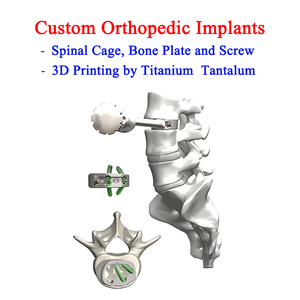
Leveraging modern CT-scan segmentations, Orthi Medical offers custom 3D printed titanium Vertebral Body Replacement (VBR) cages and patient-specific implants for complex spinal deformity, oncology resections, and revision reconstructions. Our expandable titanium cages feature continuous stepless mechanical distraction combined with 3D porous endplates.
4. Global Sourcing Trends in 3D Printed Titanium Implants (2025–2030)
As hospital procurement boards and international regulatory bodies enforce stricter cost-to-performance metrics, the market for 3D printed orthopedic implants is undergoing rapid evolution. Key sourcing trends shaping contract manufacturing include:
Trend 1: Rapid Obsolescence of Non-Porous PEEK in Favor of Additive Titanium
Surgeons worldwide are steadily phasing out un-coated PEEK implants due to documented non-union rates and pseudarthrosis risks. Sourcing directors are reallocating supply chain capital toward porous titanium cages that deliver verified fusion within 3 to 6 months post-operatively.
Trend 2: Demand for Integrated Fixation (Zero-Profile Standalone Cages)
Surgical trends favor minimally invasive procedures that eliminate anterior plate placement. Contract buyers are increasingly demanding OEM 3D printed cages with pre-engineered screw/anchor trajectory guides that allow immediate rigid fixation through a single insertion instrument.
Trend 3: Consolidation of Device Registration & Master File Regulatory Support
Navigating EU MDR (2017/745) and US FDA 510(k) clearances has elevated regulatory costs. Global buyers now favor contract factories like Orthi Medical that provide comprehensive Design History Files (DHF), Device Master Records (DMR), mechanical test reports (ASTM F2077, ASTM F2267, dynamic wear debris analysis), and biocompatibility data (ISO 10993).
Trend 4: Pre-Sterilized Ready-to-Use Packaging Models
Hospitals are shifting the financial burden of instrument washing and autoclave sterilization back to suppliers. Offering factory-sealed, gamma-sterilized single-pack implants with 5-year shelf-life stability has become a vital requirement for regional distributors entering competitive hospital tenders.
5. Enterprise Strengths & Quality Management Standard (Orthi Medical)
Orthi Medical Co., Ltd. stands as a premier ISO 13485 certified manufacturer specializing in trauma, spine, sports medicine, joint replacement, and additive manufacturing OEM solutions. Built upon decades of precision medical engineering experience, our corporate strengths include:
- ISO 13485 & ISO 9001 Quality System: Every manufacturing process operates under strict quality management protocols audited by international notified bodies. All raw materials (Ti-6Al-4V TC4/TA3/TA2 per ASTM F1472 and ASTM F67) come with complete mill certificates and chemical composition verification.
- State-of-the-Art Additive & Machining Facilities: Our manufacturing plant houses imported high-precision SLM 3D printers, German 5-axis machining centers, and automated surface treatment lines capable of producing tens of thousands of spine and trauma components monthly.
- Full In-House Biomechanical Testing: We conduct static and dynamic compression-shear fatigue testing, wear debris characterization, and cage expulsion testing in accordance with ASTM F2077, ASTM F2267, and ISO 14801 standards to ensure 100% mechanical reliability before commercial release.
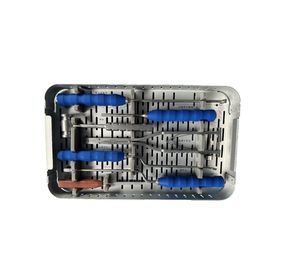
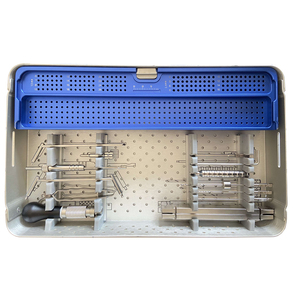
- Turnkey Private Label & Packaging Services: We provide full OEM customization including customer-specified laser engraving, anodized color-coding, customized surgical instrument tray design, cleanroom blister sealing, and regulatory filing support.
6. Frequently Asked Questions (FAQ) for OEM/ODM Buyers
What metal powder materials are used for your 3D printed cages?
How do you remove residual titanium powder from the internal porous lattice?
What is the standard porosity and pore size of your spinal lattice structure?
Can Orthi Medical produce custom cage designs based on our proprietary CAD files?
What mechanical testing documentation do you provide for regulatory submission?
What are the Minimum Order Quantities (MOQ) and production lead times for OEM projects?
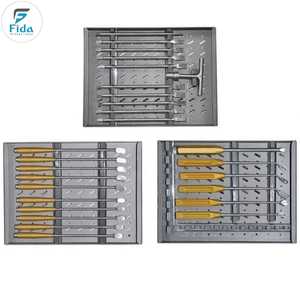
Do you offer matching surgical instrument sets for 3D printed cage systems?
Accelerate Your Orthopedic Product Line with Our 3D Printing Expertise
Partner with an ISO 13485 certified titanium contract manufacturer. Request custom CAD evaluation, mechanical test summaries, or a competitive OEM quotation today.