Executive Summary: The Evolution of OEM Veterinary Bone Plate Sourcing
An authoritative engineering and procurement overview for veterinary medical device brands, hospital procurement directors, and regional orthopedic distributors.
The global veterinary orthopedics market is undergoing a structural transformation. Driven by increasing pet humanization, advanced diagnostic imaging, and higher clinical expectations from companion animal owners, veterinary surgeons are demanding orthopedic implants that mirror human-grade surgical standards. Central to this evolution is the role of custom OEM veterinary bone plate factories and exporters capable of bridging high-precision metallurgical fabrication, biological adaptability, and robust regulatory compliance.
Historically, veterinary orthopedic implants relied on repurposed human trauma systems or standardized non-locking dynamic compression plates (DCP). However, feline and canine anatomical biomechanics differ vastly from human kinesiology. Quadrupedal weight distribution, high torsional loads during locomotion, thin cortical bone structures in toy breeds, and diverse breed-specific geometry require dedicated veterinary bone plate architectures. As an established OEM contract manufacturer and exporter, our facility integrates 5-axis CNC machining, advanced titanium anodization, and specialized micro-lok screw pitch matching to supply global partners with bespoke bone plate systems engineered specifically for animal surgery.
1. Metallurgical & Biomechanical Foundations of Veterinary Bone Plates
Selecting the optimal material and design geometry is the foundation of any successful OEM veterinary bone plate project. In veterinary trauma, bone plates must achieve rigid internal fixation to facilitate direct osseous healing (primary cortical healing) while remaining bio-inert and resistant to cyclic fatigue failure caused by uncooperative animal movement post-surgery.
1.1 Material Science: Ti-6Al-4V ELI vs. 316LVM Stainless Steel
Our factory processes two primary implant-grade materials compliant with international surgical standards:
- Titanium Alloy (Ti-6Al-4V ELI / ASTM F136 / ISO 5832-3): Titanium Extra Low Interstitial (ELI) is the premier material for veterinary locking compression plates. With a modulus of elasticity (~110 GPa) significantly closer to cortical bone (~18–22 GPa) than stainless steel (~200 GPa), titanium implants drastically minimize stress shielding. This encourages physiological stress distribution across the fracture gap, accelerating osteogenesis. Furthermore, titanium exhibits superior biocompatibility, immune quiescence, and MRI compatibility.
- Implant-Grade Stainless Steel (316LVM / ASTM F138 / ISO 5832-1): Vacuum arc remelted (VAR) stainless steel remains a cost-effective, high-tensile-strength option for large animal orthopedics (such as equine or giant-breed canine fractures). It offers high ductility, allowing intraoperative contouring without catastrophic work hardening or micro-fissure propagation.
Combi-Hole Technology
Combines dynamic compression slotting with threaded locking holes, giving surgeons intraoperative flexibility to choose between axial compression and fixed-angle locking stability.
Type II Anodization
Electrochemical surface treatment enhances anti-galling properties of titanium screw-plate interfaces while providing clear color-coded dimensional identification for operating room efficiency.
Low-Profile Scalloped Edges
Tapered plate ends and rounded profile edges reduce soft-tissue irritation, skin tenting, and vascular strangulation over subcutaneous bony prominences in small breeds.
1.2 Biomechanical Fixation Mechanisms
In traditional non-locking plating (DCP), stability relies entirely on friction between the plate underside and periosteal bone. Tightening screws compresses the plate onto the bone, which can compromise periosteal blood supply, leading to delayed union or cortical necrosis. Conversely, modern Veterinary Locking Compression Plates (LCP) utilize threaded screw heads that mechanically lock directly into matched threads within the plate holes.
This creates a fixed-angle construct. The plate does not need to press against the periosteum to achieve stability, preserving the delicate periosteal vascular network vital for rapid callus formation. In OEM manufacturing, maintaining tight pitch tolerance (±0.005mm) on these micro-threads is paramount to prevent cross-threading during high-speed surgical insertion.
Technical Specification Matrix: OEM Veterinary Bone Plate Standards
Our OEM manufacturing line produces standard, mini, and specialized veterinary plates compliant with the following mechanical thresholds:
| Plate System Series | Compatible Screw Diameter | Material Grade | Tensile Strength (MPa) | Target Clinical Indication |
|---|---|---|---|---|
| Micro-Locking 1.5mm / 2.0mm | Ø 1.5mm, Ø 2.0mm | Ti-6Al-4V ELI (ASTM F136) | ≥ 860 MPa | Feline fractures, toy canine breeds, mandible reconstruction |
| Mini-Locking 2.4mm / 2.7mm | Ø 2.4mm, Ø 2.7mm | Ti-6Al-4V ELI / 316LVM | ≥ 860 – 930 MPa | Small-to-medium dogs (radius, ulna, tibia, fibula) |
| Broad & Narrow LCP 3.5mm | Ø 3.5mm Locking & Cortical | Ti-6Al-4V ELI / 316LVM | ≥ 930 MPa | Medium-to-large canine diaphyseal fractures, TPLO surgery |
| Heavy-Duty LCP 4.5mm/5.0mm | Ø 4.5mm, Ø 5.0mm | 316LVM Stainless Steel | ≥ 1000 MPa | Giant canine breeds, equine, exotic large animal orthopedics |
| Specialized TPLO / TTA Plates | Ø 2.7mm, Ø 3.5mm | Ti-6Al-4V ELI | ≥ 900 MPa | Cranial cruciate ligament rupture correction (Tibial Osteotomy) |
2. Full-Spectrum OEM/ODM Manufacturing Capabilities
As a specialized factory and exporter, our infrastructure is optimized for private-label production, contract manufacturing, and custom anatomical plate design for international medical brand owners. We turn raw titanium bars into packaged, sterile-ready orthopedic systems through a meticulously audited internal supply chain.
2.1 Precision Machining & Swiss-Type Lathes
The intricate geometry of veterinary bone plates—including contoured curves, combi-holes, undercut screw locks, and dynamic compression slots—requires multi-axis CNC milling. Our production floor operates high-speed 5-axis CNC machining centers and precision Swiss-type CNC automatic lathes. This enables single-setup machining of complex profiles, eliminating repositioning error and guaranteeing absolute concentricity across screw threads and plate countersinks.
2.2 Surface Engineering & Finishing
Surface micro-structure directly dictates fatigue life and tissue response. Our factory utilizes multi-stage finishing processes:
- Automated Vibratory Deburring & Electro-Polishing: Removes micro-burrs and tool marks, creating a smooth surface that reduces stress concentration points where fatigue cracks originate.
- Anodization (Color Coding & Hard Anodizing): Electrochemical oxidation produces vibrant, durable oxide layers (pink, gold, blue, green) corresponding to screw diameters (e.g., Pink = 1.5mm, Blue = 2.0mm, Gold = 2.7mm, Green = 3.5mm). This prevents surgical errors in fast-paced veterinary ORs.
- Laser Marking & Matrix Barcoding: High-precision fiber lasers engrave lot numbers, part codes, and dimensional indicators on every individual plate, establishing 100% batch traceability from raw material bar stock to clinical implantation.
2.3 Cleanroom Packaging & Sterilization Support
To support turn-key private-label exporters and distributors, our facility features ISO Class 7 cleanrooms for assembly, visual inspection under magnification, and primary packaging. We offer double-blister Tyvek packaging compliant with ISO 11607 standards. Implants can be supplied clean non-sterile or pre-sterilized via Co-60 Gamma Irradiation (SAL 10-6), accompanied by validated shelf-life stability documentation.
3. Dedicated Veterinary Clinical Applications & Specialized Plate Typologies
Veterinary orthopedics encompasses a wide spectrum of patient sizes and clinical pathologies. A top-tier OEM manufacturer must offer specialized anatomical plate configurations to address specific veterinary surgical procedures.
3.1 TPLO (Tibial Plateau Leveling Osteotomy) Plates
Cranial cruciate ligament (CCL) rupture is the most prevalent orthopedic condition in canine patients. TPLO surgery stabilizes the stifle joint by altering the angle of the tibial plateau. Our OEM TPLO plates feature anatomically pre-contoured proximal heads that conform perfectly to the medial proximal tibia. Incorporating locking combi-holes, these plates resist high rotational shear forces during early weight-bearing recovery.
3.2 TTA (Tibial Tuberosity Advancement) & CBLO Systems
For alternative CCL surgical techniques, we manufacture specialized TTA cages, TTA tension band plates, and CBLO (Cranial Tibial Wedge Osteotomy) plates. Machined from high-strength titanium, these plates provide rigid fixation while maintaining a ultra-low profile to avoid subcutaneous friction.
3.3 Pancarpal & Pantarsal Arthrodesis Plates
High-energy hyperextension injuries of the carpus or tarsus require joint fusion. Our arthrodesis plates feature step-down thickness profiles—thicker across the joint space to resist bending moments, and thinner proximally/distally to prevent stress risers on the radiocarpal or tarsometatarsal bones.
3.4 Cuttable & Reconstruction Plates
Feline fractures and pelvic multi-fragment disruptions require extreme intraoperative customization. Our OEM cuttable plates feature dense hole patterns and narrow bridges, allowing surgeons to cut the plate to exact lengths and bend it in three dimensions using specialized bending pliers without sacrificing hole thread integrity.
4. Future Trends in Veterinary Implant Sourcing & Manufacturing (2025–2030)
As the veterinary orthopedic sector matures, procurement managers and brand owners must align with long-term technological and supply chain shifts. Key industry dynamics shaping the future of veterinary plate manufacturing include:
Shift 1: Additive Manufacturing (3D Printed Patient-Specific Implants)
While CNC machining remains the gold standard for high-volume standard plates, direct metal laser sintering (DMLS) 3D printing is rapidly growing for complex oncological resections, severe angular limb deformities, and revision surgeries in valuable working or racing animals. Forward-thinking OEM factories are integrating hybrid additive-subtractive workflows, using 3D printing to generate porous trabecular titanium surfaces for rapid bone ingrowth, followed by CNC finish-machining of precision screw locking threads.
Shift 2: Transition from Non-Locking to Universal Hybrid Locking Systems
Global demand is rapidly shifting away from legacy DCP plates toward universal hybrid locking compression systems. Importers who update their product lines to feature variable-angle locking technology gain a distinct competitive edge, as veterinary clinics seek to shorten operative times and lower postoperative complication rates.
Shift 3: Sterile-Packaged Single-Implant Kitting
Traditional veterinary hospitals purchased bulk non-sterile implants stored in open trays, requiring hospital personnel to clean and autoclave plates prior to surgery. The global trend is moving toward single-use, pre-sterilized, barcode-traceable sterile kits. This transition lowers hospital overhead, eliminates sterilization validation risks for clinics, and generates recurring revenue streams for distributors.
Shift 4: Supply Chain Consolidation & Quality Regulatory Audits
Western distributors are consolidating their vendor bases, partnering with OEM factories that possess full ISO 13485 certification, complete material heat-number traceability, and ready-to-file Technical Files (STED format) for national medical device registration (such as US FDA, EU MDR, and regional regulatory bodies).
5. Comprehensive Technical FAQ for OEM Procurement & B2B Importers
What certifications and quality systems govern your veterinary bone plate manufacturing?
Can your factory produce custom anatomical bone plate designs from customer 3D CAD files?
What is the typical Minimum Order Quantity (MOQ) and lead time for private-label orders?
How do you prevent cross-threading and galling in titanium locking screw-plate interfaces?
What packaging options are available for global exporters and medical distributors?
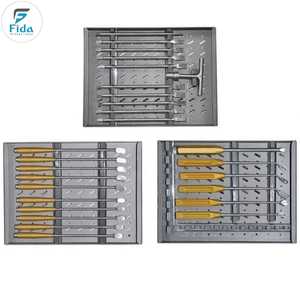
Do you provide matching surgical instrument sets and sterilisation caddies?
6. Strategic OEM Manufacturing Partnership & Procurement Next Steps
Navigating the competitive landscape of veterinary medical devices requires an OEM partner that combines technical mastery, material integrity, and reliable export fulfillment. By consolidating your bone plate manufacturing with our ISO 13485 certified facility, you secure direct factory pricing, absolute design confidentiality (backed by comprehensive non-disclosure agreements), and predictable lead times for global distribution.
Whether you are launching a new proprietary veterinary locking plate line, expanding your regional orthopedic catalog, or seeking a secondary manufacturing vendor to de-risk your global supply chain, our engineering team is prepared to turn your technical specifications into clinical-grade surgical implants.