Featured Orthopaedic Products & Instrument Solutions
Explore our CE & ISO 13485 certified implant systems engineered for precision surgical performance.
Executive Overview: Custom OEM/ODM Orthopaedic Manufacturing Excellence
As a leading international custom OEM orthopaedic implant manufacturer and specialized factory, Orthi Medical Co., Ltd. delivers high-precision implantable devices and specialized surgical instrumentation tailored to global medical brands, healthcare distributors, and OEM purchasing organizations. Managing complex orthopaedic manufacturing requires rigorous adherence to materials science, biomechanical fatigue design, micro-scale precision machining, and strict regulatory compliance.
From complex multi-axial pedicle screws and variable-angle trauma locking plates to total hip replacement prostheses and arthroscopic shaver cutters, our technical engineering team provides end-to-end support—encompassing Design for Manufacturability (DFM), prototype prototyping, surface anodization, Class 100,000 cleanroom assembly, and complete technical dossier assembly for local market registration.
End-to-End Contract Manufacturing Lifecycle
A disciplined 5-stage engineering workflow guaranteeing 100% material traceability and geometric accuracy.
DFM & Engineering Review
Detailed CAD/CAM analysis, finite element modeling (FEA) verification, tolerance optimization, and material selection per ASTM/ISO specifications.
5-Axis CNC Precision Milling
Swiss-type micro-turning and 5-axis simultaneous CNC milling delivering tolerances within ±0.005mm for intricate spinal and joint implants.
Surface Engineering & Coating
Type II/III color anodization, plasma spray Hydroxyapatite (HA) coating, sandblasting, electropolishing, and laser micro-marking.
Metrology & Quality Audit
Coordinate Measuring Machine (CMM) verification, optical comparator checking, mechanical static/fatigue testing, and metallurgical certificate verification.
Cleanroom & Gamma Sterilization
ISO Class 7 (Class 100,000) cleanroom secondary packaging in dual Tyvek pouches, followed by Co-60 Gamma Sterilization (SAL 10⁻⁶).
Comprehensive Orthopaedic & Surgical Portfolio
Trauma Fixation Systems
Our trauma solutions offer complete fracture management options across upper extremity, lower extremity, thoracic, and pelvic anatomical sites:
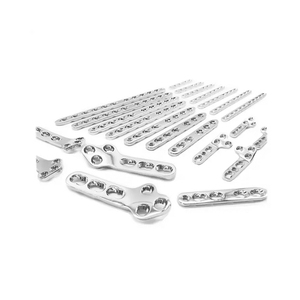
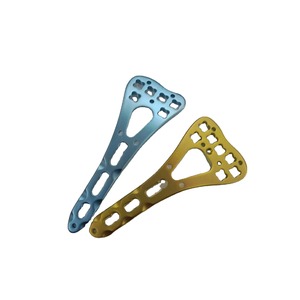
- Variable-Angle Locking Compression Plates (LCP): Anatomically pre-contoured plates for distal radius, proximal humerus, distal femur, and tibia.
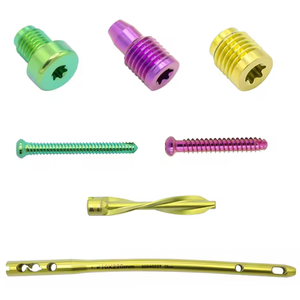
- Intramedullary Nailing Systems: Interlocking tibial nails, femoral nails, and Proximal Femoral Nails (PFN) with helical blade mechanisms.
- Cannulated Screws: Ø2.5mm to Ø6.5mm reverse-cutting compression screws manufactured from high-strength Ti-6Al-4V alloy.
- Thoracic Reconstructive Plates: Low-profile titanium rib locking plates designed for chest wall stabilization.
Spinal Implants & MIS Surgery
Comprehensive spinal reconstruction solutions engineered to restore sagittal balance and accelerate interbody fusion:
- Posterior Thoracolumbar Systems: Dual-thread cannulated & fenestrated pedicle screws compatible with bone cement injection.
- Interbody Fusion Devices: Radiolucent PEEK cages (TLIF, PLIF, ALIF, Cervical) featuring tantalum radiopaque markers.
- Anterior Cervical Plates: Ultra-low 2.0mm profile plates with single-step integrated friction-locking mechanisms.
- Kyphoplasty Systems: High-pressure balloon dilatation catheters and bone cement delivery injectors for osteoporotic compression fractures.
Joint Arthroplasty & Sports Medicine
Restoring joint function through biocompatible tribological designs and arthroscopic solutions:
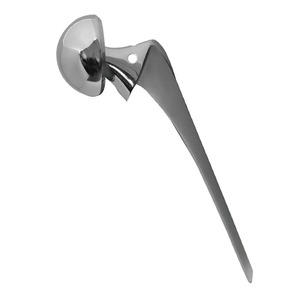
- Total Hip Arthroplasty (THA): Cementless HA-coated titanium stems, ceramic/UHMWPE acetabular cup liners, and bipolar heads.
- Total Knee Arthroplasty (TKA): CoCrMo femoral components paired with highly cross-linked polyethylene (HXLPE) tibial inserts.
- Arthroscopy Consumables: Serrated shaver blades, burs, and PEEK suture anchors for shoulder rotator cuff and ACL reconstruction.
- Minimally Invasive Endoscopy (UBE): 4K UHD video cameras, spinal endoscopes, and bipolar RF plasma ablation probes.
Metallurgical Compliance & Chemical Specifications
Raw material validation conducted under strict international standards to ensure mechanical strength and biostability.
| Material Alloy | Specification Standard | Tensile Strength (MPa) | Yield Strength (MPa) | Primary Clinical Application |
|---|---|---|---|---|
| Ti-6Al-4V ELI | ASTM F1472 / ISO 5832-3 | ≥ 930 MPa | ≥ 860 MPa | Pedicle Screws, Trauma Plates, Femoral Stems |
| Unalloyed Titanium (Gr 2/3) | ASTM F67 / ISO 5832-2 | ≥ 400 - 500 MPa | ≥ 275 - 380 MPa | Cervical Plates, Cranio-maxillofacial Fixation |
| PEEK-OPTIMA® | ASTM F2026 | ≥ 95 MPa | ≥ 90 MPa | Interbody Fusion Cages, Suture Anchors |
| Co-28Cr-6Mo Alloy | ASTM F75 / ISO 5832-4 | ≥ 665 MPa | ≥ 450 MPa | Knee Femoral Heads, Acetabular Metal Backs |
| UHMWPE / HXLPE | ASTM F648 / ISO 5834-2 | ≥ 40 MPa | ≥ 21 MPa | Joint Bearings, Acetabular Liners |
Future Trends in Global Orthopaedic Implant Purchasing (2025–2035)
Strategic insights for OEM buyers, hospital procurement committees, and device distributors.
1. Shift Toward Pre-Sterile Packaged Implants
Hospitals worldwide are phasing out bulk, non-sterile implant trays due to the rising costs of in-hospital autoclave sterilization and contamination risks. Pre-sterilized implants (gamma-irradiated to SAL 10⁻⁶ in individual Tyvek blister packs) streamline operating room turn-around times, ensure 100% lot traceability via UDI barcoding, and eliminate hospital reprocessing expenses.
2. 3D-Printed Porous Titanium & PSI Integration
Additive manufacturing via Electron Beam Melting (EBM) and Direct Metal Laser Sintering (DMLS) is replacing conventional subtractive machining for complex interbody cages and joint augments. Porous structures mimicking trabecular bone structure (60–70% porosity with 300–500μm pore size) yield significantly improved osseointegration rates compared to smooth titanium surfaces.
3. Supply Chain Localization & Technical Dossiers
With EU MDR enforcement and stringent FDA 510(k) audits, distributors require OEM partners that offer more than basic manufacturing. Successful suppliers must provide full technical documentation—including ISO 10993 cytotoxicity reports, mechanical static/fatigue data (ISO 14801, ASTM F2077), clinical evaluation reports (CER), and cleanroom environmental monitoring logs.
Why Partner with Orthi Medical Co., Ltd.?
A dependable, vertically integrated manufacturer committed to healthcare quality and long-term partnership.
In-House Vertical Manufacturing
Unlike trading agents, our dedicated facility executes every phase of production internally—from raw material bar stock cutting, 5-axis machining, laser engraving, surface anodization, to cleanroom heat sealing. This structural control ensures stable cost structures, protected intellectual property, and reliable lead times.
Academic & Clinical Support
We actively bridge industrial design with surgeon practice. Orthi Medical supports global distributors by delivering step-by-step surgical technique manuals, sponsoring cadaveric workshop sessions, providing sawbone demonstration kits, and hosting academic exchange conferences to build surgeon confidence.
Frequently Asked Procurement Questions (FAQ)
Clear answers to assist buying teams, regulatory managers, and medical device importers.
Partner with a Certified Orthopaedic OEM Manufacturer
Initiate your OEM project or request detailed product catalogs, material certificates, and B2B wholesale pricing today. Our international sales and engineering teams respond within 24 hours.
Inquire Now