Flagship Meniscal Repair Devices & Surgical Passers
1. Executive Overview & Clinical Rationale in Joint Preservation
The Paradigm Shift from Partial Meniscectomy to All-Inside Anatomic Meniscal Repair
Biomechanical Hoop Stress Retention
Peripheral meniscal tears disrupt circumferential hoop stress distribution. Our custom OEM All-Inside devices utilize ultra-high-molecular-weight polyethylene (UHMWPE) suture constructs pre-loaded into medical-grade PEEK implants. This configuration guarantees initial pull-out loads exceeding 350 N, resisting cyclic displacement under physiologic walking loads.
Neurovascular Safety & Minimally Invasive Portals
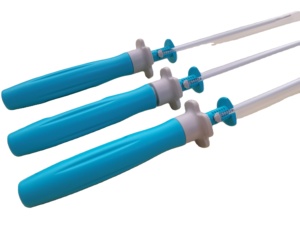
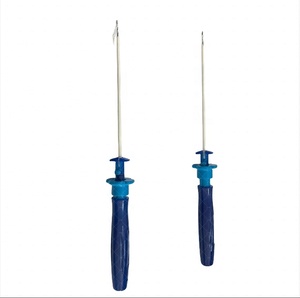
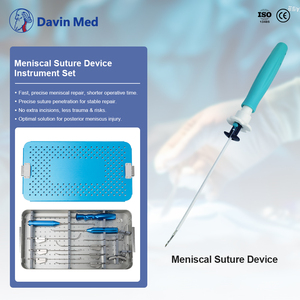
Conventional Inside-Out techniques necessitate posterior auxiliary incisions to capture needles, increasing the risk of saphenous or peroneal nerve injury. Advanced OEM All-Inside suture passers feature integrated depth-limiting sheaths and superelastic Nitinol delivery needles, permitting 100% intra-articular deployment without secondary posterior incisions.
2. Engineering Architecture & Material Science
Biocompatible Metallurgy, High-Tension Polymers, and Precision Micro-Machining
Polyether Ether Ketone (PEEK) Implants — ASTM F2026 Specification
Our All-Inside repair systems utilize implants machined or precision-molded from radiolucent PEEK-OPTIMA™. Offering an elastic modulus (3.6 GPa) closely matching cortical bone and native fibrous tissue, PEEK anchors eliminate stress shielding while preventing soft tissue abrasion. The low-profile geometry (typically < 5 mm length, < 1.3 mm width) minimizes intra-articular bulk, suppressing joint line irritation.
Ultra-High-Molecular-Weight Polyethylene (UHMWPE) Sutures
Suture material failure is the primary failure mode in soft tissue repair. We integrate #2-0 non-absorbable UHMWPE co-braided suture tapes. The high-density fiber structure provides exceptional knot security, zero creep strain under load, and reduced tissue cut-through ("cheese-cutter effect") compared to traditional monofilament or polyester sutures.
Superelastic Nitinol & Surgical Stainless Steel Needle Delivery
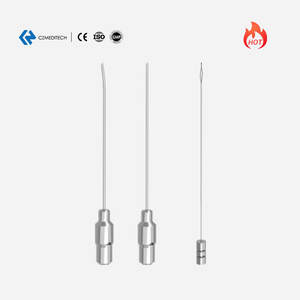
The needle delivery shaft requires high flexural fatigue resistance to maneuver within the tight notch of the knee joint. We utilize shape-memory Nitinol (NiTi) alloy shafts paired with custom 316LVM surgical stainless steel tips, guaranteeing consistent penetration force through dense posterior horn tears without needle bowing or tip deformation.
Biomechanical Performance & Technical Comparison Matrix
| Fixation Technique / System | Primary Anchor Material | Suture Strain Modulus | Mean Ultimate Load (N) | Neurovascular Risk | OR Setup Time |
|---|---|---|---|---|---|
| All-Inside Fast-Fix System (OEM Custom) | PEEK (ASTM F2026) / PLLA | UHMWPE #2-0 Tape | 380 N ± 25 N | Negligible (< 0.1%) | 12 – 15 Minutes |
| Traditional Inside-Out Passers | No Anchor (Direct Suture) | 2-0 Polyester / Braided | 210 N ± 30 N | Moderate (Requires Counter-Incision) | 35 – 45 Minutes |
| Outside-In Needle Systems | Direct Suture / Knot Tag | #0 Monofilament / PDS | 160 N ± 18 N | Low to Moderate | 25 – 30 Minutes |
| Bioabsorbable Meniscal Staples | PLLA / PGA Copolymer | N/A (Rigid Staple) | 110 N ± 15 N | Negligible | 15 – 20 Minutes |
3. Future Sourcing & Technical Development Trends (2025–2030)
Key Market Drivers Reshaping Global Medical Device Procurement
1. Needleless & Micro-Cannular Delivery
Next-generation sports medicine procurement is moving toward ultra-small profile inserters (< 2.0 mm outer diameter). Minimizing portal diameter reduces Iatrogenic cartilage scuffing during insertion through tight medial compartments. OEM exporters are investing heavily in thin-walled Nitinol drawing technologies to reduce outer shaft profile while retaining torsional rigidity.
2. Biocomposite & Resorbable Scaffolding
While PEEK remains the gold standard for non-absorbable fixation, biocomposite materials combining Poly(L-lactide-co-D,L-lactide) (PLLA/PDLLA) with micro-fine β-tricalcium phosphate (β-TCP) are gaining market share. These implants provide structural osteoconductivity and gradual resorption over 24 to 36 months, replacing synthetic anchors with native tissue.
3. Pre-Tensioned Self-Sliding Knot Constructs
Surgeon skill variability during intra-articular knot tying introduces tension inconsistencies. Future procurement demands pre-assembled suture constructs featuring pre-tied, self-sliding cinch knots that lock automatically upon reaching designated tension thresholds, streamlining procedure times and ensuring uniform biomechanical tension.
4. Turnkey OEM Contract Manufacturing Consolidation
Hospital networks and multinational distributors are reducing vendor fragmentation. Global buyers increasingly favor qualified contract manufacturers capable of supplying total turnkey solutions—ranging from Swiss CNC machining of passers and sterile packaging to regulatory technical files (STED) for fast-track regional registration.
4. Contract Manufacturing & OEM Customization Ecosystem
End-to-End Precision Machining, Private Labeling, and ISO Class 7 Packaging
A. Precision Swiss CNC & Laser Welding
Utilizing 5-axis Citizen and Tsugami Swiss-type CNC lathes, we manufacture micro-components with tolerances down to ±0.003 mm. Laser-welded shaft-to-handle assemblies undergo non-destructive torque and pull testing to prevent intraoperative detachment.
B. Surface Modifications & Anodizing
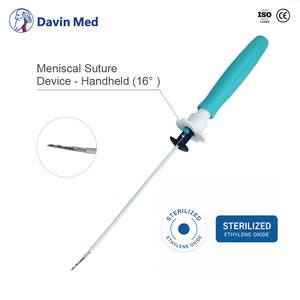
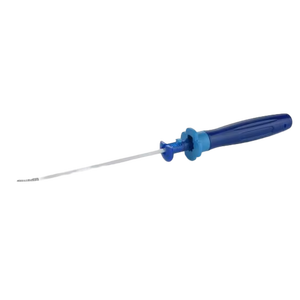
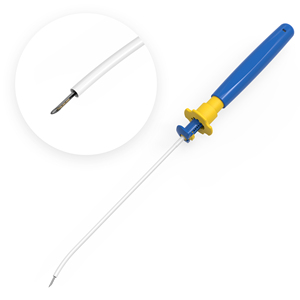
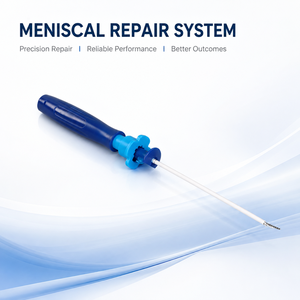
Instrument shafts feature glare-reducing matte finishes or biocompatible Type II titanium anodization. Color-coded handles (Alloy 6061-T6 aluminum) provide immediate intraoperative identification for straight, curved-up, and kick-down shaft configurations.
C. ISO Class 7 Cleanroom & Gamma Sterilization
Implants and pre-loaded suturing devices are assembled in audited ISO Class 7 cleanrooms. Products undergo Co-60 Gamma Irradiation achieving a Sterility Assurance Level (SAL) of 10⁻⁶ in compliance with ISO 11137 standards.
5. Quality Assurance, Certifications & Corporate Infrastructure
Full Traceability from Raw Titanium Bar to Final Sterilization Packaging
Raw Material Inspection & Standard Alignment
Every batch of raw material is backed by certified chemical composition and tensile strength mill reports:
- Pure Titanium (TA2/TA3): ASTM F67 Compliant (Tensile Strength ≥ 400–500 MPa)
- Titanium Alloy (Ti-6Al-4V TC4): ASTM F1472 Compliant (Tensile Strength ≥ 930 MPa)
- PEEK Polymer: ASTM F2026 Medical Grade Specifications
- Stainless Steel Passers: ASTM F899 Surgical Grade Stainless Steel
Quality Control Testing & Verification
Every OEM manufacturing run undergoes rigorous physical, mechanical, and biological testing protocols before product release:
- 100% Optical CMM dimensional verification on high-stress components.
- Cyclic fatigue and ultimate load pull-out testing per ASTM F2267 standards.
- Bacterial endotoxin testing (LAL test) ensuring < 20 EU/device.
- Accelerated real-time package aging validation per ISO 11607.
6. B2B Sourcing FAQ: Custom OEM Meniscal Repair Devices
Technical Answers for Procurement Managers, Distributors, and Regulatory Teams
As an ISO 13485:2016 certified manufacturer, we provide complete technical documentation dossiers aligned with EU MDR (2017/745) STED guidelines and US FDA 510(k) requirements. This includes raw material mill certificates (ASTM F2026 for PEEK, ASTM F1472 for TC4 titanium), biocompatibility test reports (ISO 10993), sterilization validation (ISO 11137), shelf-life stability reports (ISO 11607), and biomechanical pull-out verification data.
Yes. We specialize in custom OEM/ODM contract manufacturing based on customer 2D/3D CAD drawings or physical prototypes. Our CNC 5-axis bending and grinding centers allow precise customization of needle radii (e.g., straight, 12° curved-up, 24° curved-up, reverse curve), sheath outer diameters (from 1.8 mm to 2.8 mm), and custom handle colors via Type II anodization with custom laser-etched brand logos.
Our standard All-Inside meniscal repair systems come pre-loaded with #2-0 Ultra-High-Molecular-Weight Polyethylene (UHMWPE) non-absorbable braided suture or #2-0 UHMWPE co-braided with polyester for superior knot visibility. Suture tapes with a wider surface area (1.1 mm to 1.5 mm width) are also available upon request to prevent soft tissue cutting under high dynamic tensile loads.
Implants are packaged inside double-layer Tyvek® blister trays heat-sealed under controlled environmental parameters in our ISO Class 7 cleanrooms. Primary packaging undergoes accelerated aging testing according to ASTM F1980, guaranteeing a 3-year to 5-year sterile shelf life. Products are sterilized via Co-60 Gamma Irradiation reaching SAL 10⁻⁶.
For standard private-label packaging using existing validated device geometries, our baseline MOQ is typically 100 to 500 units per catalog SKU, with lead times ranging from 4 to 6 weeks. For fully customized OEM devices requiring new mold tooling, prototype verification, and custom cleanroom setup, lead times average 8 to 12 weeks following sample sign-off.
Yes. All repair delivery systems, cannulas, suture passers, and accessory instruments (shaver blades, radiofrequency probes, drill guides) are engineered to integrate seamlessly with standard 4.0 mm 30° and 70° arthroscopes and standard surgical portals without requiring proprietary accessories.
During cleanroom assembly, 100% of All-Inside inserters undergo trigger-mechanism actuation verification, depth-stop friction alignment checks, and needle-tip sharpness optical inspections. Suture retention nodes are pull-tested to a pre-set threshold to prevent knot unraveling during deployment.
Yes. We provide flexible packaging configurations including non-sterile bulk packaging in protective cleanroom bags, ready for local packaging, labeling, and EtO (Ethylene Oxide) or Gamma sterilization by the client.
Partner with a Leading Custom OEM Meniscal Repair Exporter
Elevate your sports medicine product line with high-tension PEEK implants, superelastic Nitinol passers, and ISO 13485 contract manufacturing expertise.
Get Catalog